








Why did the landslide happen in Wayanad?
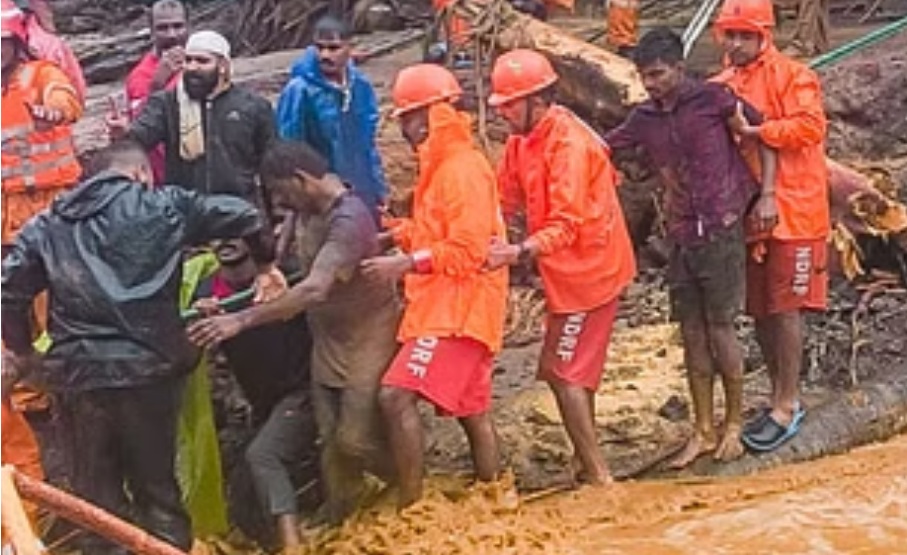
“Three major landslides occurred in the hilly areas near Meppadi in Wayanad district on Tuesday morning. Massive landslides occurred in Meppadi, Mundakkai town and Choorlamala.
The first landslide occurred in Mundakkai town at around 1 am during heavy rains. The rescue operation was still going on when the second landslide occurred near Choorlamala school at around 4 am.
Due to this, the school and nearby houses and shops were flooded with water and mud. 13 hours after the disaster, a team of NDRF and army personnel crossed the river and reached Mundakkai. Mundakkai is 3.5 km away from Choorlamala”
Wayanad 30/07/2024 reporting by santosh seth
The landslide incident has claimed the lives of more than 100 people. Hundreds of people have been injured in this disaster and are being treated in hospitals.
The effect of this natural disaster is visible at all three places where the incident took place.
The Choorlamala landslide is the biggest disaster in Kerala after the 2018 floods. The Choorlamala market has disappeared due to the landslide. There is no exact count of how many houses were destroyed.
In the Mundakkai area, only the roofs of many houses are left. Bodies are lying everywhere, they could not be transported to Meppadi.
Information was received from Mundakkai that bodies are lying near the fallen buildings. There is no way to reach them.
The bodies were taken in some vehicles to Mundakkai. The bodies of people trapped in the landslide in Wayanad also flowed several kilometers away to the neighboring district Malappuram.
More than 20 bodies have been found so far from different parts of the Chaliyar river in Malappuram district.
Meanwhile, the rescue operation had to be stopped due to sudden rise in water level in Mundakkai river.
People there are pleading on phone to at least save our children from Mundakkai. Due to houses being destroyed, there is also shortage of food and water.
Due to being without electricity for 12 hours, many people’s phones have stopped working, which is affecting the rescue operation.
The landslide incident has claimed the lives of more than 100 people. Hundreds of people have been injured in this disaster and are being treated in hospitals.
The effect of this natural disaster is visible at all three places where the incident took place.
The Choorlamala landslide is the biggest disaster in Kerala after the 2018 floods. The Choorlamala market has disappeared due to the landslide. There is no exact count of how many houses were destroyed.
In the Mundakkai area, only the roofs of many houses are left. Bodies are lying everywhere, they could not be transported to Meppadi.
Information was received from Mundakkai that bodies are lying near the fallen buildings. There is no way to reach them.
The bodies were taken in some vehicles to Mundakkai. The bodies of people trapped in the landslide in Wayanad also flowed several kilometers away to the neighboring district Malappuram.
More than 20 bodies have been found so far from different parts of the Chaliyar river in Malappuram district.
What is the reason behind the landslide?
The landslide incident in Wayanad is not new. Yes, this time the impact of the incident has been widespread. On August 8, 2019, a tragedy occurred in Puthumala area of Wayanad itself.
17 people lost their lives in that landslide incident. About five years later, a similar incident has happened in nearby Meppadi.
Landslides are active in many places in Wayanad during heavy rains, but no one had imagined such a disaster.
Joseph John, a scientist at MS Swaminathan Research Foundation, Kalpatta, gave information about the landslide areas and topography of Wayanad to the local newspaper Manorama.
Joseph said that the main reason behind these incidents is the soil here. It has been raining continuously in Wayanad for the last two weeks.
The soil here gets more water than its capacity to absorb. Landslides in Wayanad, Mundakkai and Choorlamala occur in a soil called ‘black laterite’.
This is a type of soil that is not very hard and absorbs water quickly and also drains it quickly.
When there is continuous heavy rainfall, the soil is not able to absorb all the water into the ground.
Dr. MG Manoj, scientist at CUSAT Radar Research Center, told ‘Manorama Online’ that the soil has a limited capacity to absorb water.
Every soil has different water holding capacity. If you put a little sugar in water, it will dissolve. If you pour it continuously, it will not dissolve.
The same is the case with soil. If it rains continuously, it is not able to absorb water. If the water exceeds the limit, the soil will not accept it. When this happens, landslides can occur in mountain water.
The second reason for the landslide is believed to be heavy rainfall and the nature of the area.
Since the time of the British, this area has been considered uninhabited and prone to landslides and subsidence.
No one lived here in old times. In recent years, people are coming under migration.
The reason for excessive rainfall is climate change. The rain that started on Monday night (July 29) has not stopped yet.
Wayanad Puthumala has received 372 mm of rain in the last 24 hours. The topography here is not capable of bearing so much rain in a single day.
More than double the amount of rain that should fall in the month of July has already fallen.
Dr. S. Abhilash, Associate Professor, Department of Meteorology, Kochi University, told a newspaper that Mundakkai and Choorlamala are only three kilometers away from the Kavalpara and Puthumala areas where the landslide occurred in 2019.
This is an extremely sensitive area from the environmental point of view where landslides are usually prone.
Also, heavy rainfall is a cause of landslides. This phenomenon is like a mini cloud burst. It is called a meso scale mini cloud burst because it rains heavily, 15 to 20 cm in two to three hours. This is what is happening now in northern Kerala.
The next phenomenon is ‘swale piping’. This phenomenon is like rats digging burrows inside the ground.
There is no problem visible at the top but from the bottom of the hill, soil, water and stones will flow like a tunnel.
When this happens, the upper part of the hill settles down in one go. Dr MG Manoj clarified that how the landslide happened can be evaluated according to the topography of each place. However, the basis of everything is heavy rainfall.