







PM Modi launches two major agriculture sector schemes with an outlay of Rs 35,440 crore
“Prime Minister Shri Narendra Modi participated in a special agriculture program at the Indian Agricultural Research Institute in New Delhi on October 11, 2025, at 10:30 am”
New Delhi 12/10/2025 Report by Santosh Seth
The Prime Minister also interacted with farmers and then attended a public event where he addressed the gathering.This program underscored the Prime Minister’s continued commitment to farmer welfare, agricultural self-reliance, and strengthening rural infrastructure.
The program focused on promoting modern agricultural practices, supporting farmers, and celebrating significant achievements in farmer-centric initiatives.
The Prime Minister launched two major schemes in the agriculture sector with an outlay of ₹35,440 crore. He also launched the Pradhan Mantri Dhan Dhanya Krishi Yojana with an outlay of ₹24,000 crore.
It aims to increase agricultural productivity, promote crop diversification and adopt sustainable agricultural practices, increase post-harvest storage capacity at the Panchayat and block levels, improve irrigation facilities, and facilitate the availability of long-term and short-term credit in 100 selected districts.
The Prime Minister also launched the Mission for Self-Reliance in Pulses with an outlay of ₹11,440 crore. It aims to improve pulse productivity, expand the area under pulse cultivation, strengthen the value chain – procurement, storage, and processing – and ensure reduction in losses.
The Prime Minister inaugurated projects worth over ₹5,450 crore in the agriculture, animal husbandry, fisheries, and food processing sectors, while also laying the foundation stone for additional projects worth approximately ₹815 crore.
Projects inaugurated by the Prime Minister include Artificial Insemination Training Centres in Bengaluru and Jammu and Kashmir; Centres of Excellence in Amreli and Banas; establishment of an Artificial Insemination Laboratory in Assam under the Rashtriya Gokul Mission; milk powder plants in Mehsana, Indore, and Bhilwara; a fish feed plant under the Pradhan Mantri Matsya Sampada Yojana in Tezpur, Assam; infrastructure for agro-processing clusters, integrated cold chain, and value addition infrastructure, etc.
The projects for which the Prime Minister laid the foundation stone include Integrated Cold Chain and Value Addition Infrastructure (Irradiation) in Krishna, Andhra Pradesh; and a state-of-the-art Integrated Aquapark in Hirakud, Odisha.
During the event, the Prime Minister distributed certificates to certified farmers, Maitri technicians, and Primary Agricultural Cooperative Credit Societies (PACS) converted into Pradhan Mantri Kisan Samriddhi Kendras (PMKSKs) and Common Service Centres (CSCs) under the National Mission for Natural Farming.
The event also marked significant achievements under government initiatives, including 50 lakh farmer memberships in 10,000 FPOs, of which 1,100 FPOs recorded an annual turnover of over ₹1 crore in 2024-25.
Other achievements included certification of 50,000 farmers under the National Mission for Natural Farming; certification of 38,000 Maitri (Multipurpose AI Technicians in Rural India); These include the approval and operationalization of over 10,000 multipurpose and e-PACS for computerization; and the formation and strengthening of PACS, dairy, and fisheries cooperatives. Over 10,000 PACS have diversified their operations to function as Pradhan Mantri Kisan Samriddhi Kendras (PMKSKs) and Common Service Centers (CSCs).
During the event, the Prime Minister interacted with farmers engaged in pulse cultivation who have benefited from various government schemes aimed at establishing a value-chain-based approach in agriculture, animal husbandry, and fisheries.
These farmers have also received support through membership of Farmer Producer Organizations (FPOs) and the Agriculture Infrastructure Fund.
The Prime Minister launched two major schemes in the agriculture sector with an outlay of ₹35,440 crore. He launched the Pradhan Mantri Dhan Dhanya Krishi Yojana with an outlay of ₹24,000 crore.
Shri Modi also launched the Mission for Self-Reliance in Pulses with an outlay of ₹11,440 crore. The Prime Minister inaugurated projects worth over ₹5,450 crore in the agriculture, animal husbandry, fisheries, and food processing sectors. He also laid the foundation stone for additional projects worth approximately ₹815 crore.
Addressing the nation, the Prime Minister said, “Today is a historic day that marks the birth anniversary of two great sons of Mother India who redefined India’s democratic fabric and rural development.
Jayaprakash Narayan and Nanaji Deshmukh were the voices of rural India and dedicated their lives to the empowerment of farmers and the underprivileged.”
On this important occasion, the Prime Minister emphasized that the Pradhan Mantri Dhan Dhanya Krishi Yojana and the Pulse Self-Reliance Mission (Pulse Self-Reliance Mission) are designed to usher in a new era of self-reliance, rural empowerment, and agricultural innovation.
This will directly benefit millions of farmers across the country. “The Government of India will invest over ₹35,000 crore in these initiatives, reflecting its unwavering commitment to doubling farmers’ income and achieving food and nutrition security for the country,” Mr. Modi said.
The Prime Minister emphasized the central role of agriculture and farming in India’s development journey. Addressing the nation, Prime Minister Modi recalled the long-standing neglect of the agricultural sector under previous governments and expressed his commitment to empowering India’s farmers.
He stated that rapidly developing 21st-century India requires a robust and reformed agricultural system, and that this transformation began after his government came to power in 2014.
Mr. Modi said, “We broke the apathy of the past. From seeds to markets, we implemented comprehensive reforms in the interest of our farmers.
These reforms were not just policy changes; they were structural interventions aimed at making Indian agriculture modern, sustainable, and accessible.”
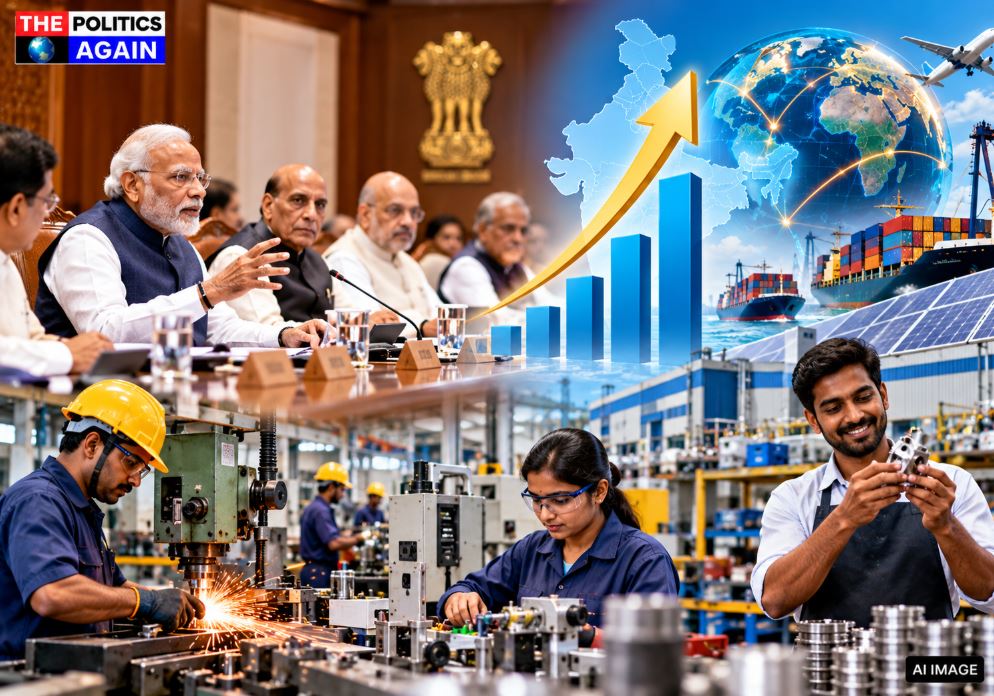
The Prime Minister noted that India’s agricultural exports have nearly doubled in the last eleven years. He stated that food grain production has increased by nearly 90 million metric tons.
Mr. Modi pointed out that fruit and vegetable production has increased by over 64 million metric tons. He said that India today ranks first in the world in milk production and is the second largest fish producer globally.
Mr Modi said that honey production has doubled compared to 2014 and egg production has also doubled in the same period.
He reported that during this period, six major fertilizer plants have been established in the country. Mr. Modi said that more than 250 million soil health cards have been distributed to farmers.
The Prime Minister said that micro-irrigation facilities have reached 100 lakh hectares of agricultural land. Mr. Modi said that insurance claims worth ₹2 lakh crore have been disbursed to farmers under the Crop Insurance Scheme.
The Prime Minister stated that over the past eleven years, more than 10,000 Farmer Producer Organizations (FPOs) have been created to enhance farmer cooperation and market access.
The Prime Minister stated that he has interacted with farmers, fishermen, and women working in agriculture. He listened to their experiences and suggestions and said that such interactions reflect the real transformation taking place in Indian agriculture.
The Prime Minister stated that the current sentiment in the nation is no longer satisfied with limited achievements. He emphasized that if India is to become a developed country, continuous improvement and progress in every sector is essential. Mr. Modi stated that the Pradhan Mantri Dhan-Dhanya Krishi Yojana has been launched with this vision.
The Prime Minister noted that this new agricultural initiative was inspired by the success of the Aspirational Districts Programme.
He recalled how previous governments had declared over a hundred districts in the country “backward” and then largely neglected them.
Mr. Modi said that, in contrast, our government chose to focus on these districts with a targeted and dynamic approach and redesignated them as “aspirational districts.”
He outlined a strategy of adaptation, collaboration, and competition for change in these districts. “All efforts were united under the spirit of ‘Sabka Prayas’ (everyone’s effort) and a model of healthy competition was encouraged among the districts for rapid development,” Mr. Modi emphasized.
The Prime Minister noted that in these more than 100 districts, nearly 20 percent of villages had never seen a road since independence.
Mr. Modi said, “Today, due to the focused implementation of the Aspirational Districts Programme, most of these villages are connected with all-weather roads.” He also highlighted improvements in healthcare delivery.
The Prime Minister noted that at the start of the programme, 17 percent of children in these districts were outside the scope of basic immunization.
Now, most of these children have been fully immunized. Mr. Modi said, “More than 15 percent of schools in these districts lacked electricity.
Today, almost every such school has electricity connection, ensuring a more conducive learning environment for children.” He said that these achievements are a direct result of a development model based on adaptation, cooperation, and competition, where coordinated efforts of various departments and active participation of citizens have yielded tangible results.
Mr. Modi emphasized that the inspiration behind the Pradhan Mantri Dhan-Dhanya Krishi Yojana comes directly from the success of the Aspirational Districts Model.
The Prime Minister said, “These 100 districts have been carefully selected based on three key criteria: first, the level of agricultural production per unit of land.
Second, the number of crops grown on the same land in a year. Third, the availability and extent of institutional credit or investment facilities for farmers.”
Mr. Modi said, “We have often heard the phrase ‘36 figures,’ which implies that two sides are completely at odds with each other.
But as a government, we challenge and overturn such notions.” He emphasized that under the Pradhan Mantri Dhan Dhanya Krishi Yojana, we are bringing together 36 different government schemes in an integrated and coordinated manner.
Whether it’s the National Mission on Natural Farming, the ‘Per Drop More Crop’ campaign for efficient irrigation, or the Oilseeds Mission to boost oilseed production, several such initiatives, including a special focus on livestock development, are being integrated under one umbrella.
Mr. Modi said, “Under the Pradhan Mantri Dhan Dhanya Krishi Yojana, local livestock health campaigns will also be launched to ensure continuous care and disease prevention at the grassroots level.”
The Prime Minister further emphasized that, like the Aspirational Districts Programme, the PM Dhan Dhanya Krishi Yojana places a significant responsibility not only on farmers but also on local government officials, especially the District Magistrate or Collector of each district.
The scheme’s design provides flexibility so that the plan can be tailored to the specific needs of each district. “Therefore, I urge farmers and District Magistrates to prepare district-level action plans that are suited to local soil and climatic conditions,” Mr. Modi emphasized.
Shri Modi stated that the objective of the Pulses Self-Reliance Mission is not only to increase pulses production but also to strengthen the country’s future generations.
The Prime Minister highlighted that Indian farmers have recently achieved record production of food grains like wheat and rice, making India one of the world’s top producers.
Shri Modi said, “However, nutrition requires looking beyond just flour and rice. While these staple foods can satisfy hunger, proper nutrition requires a more diverse diet.
Protein, especially for India’s largely vegetarian population, plays a vital role in both physical and mental development. Pulses remain the most important source of plant-based protein.”
He emphasized, “The Pulses Self-Reliance Mission seeks to address this challenge by promoting domestic pulse production, which will enhance nutritional security and self-sufficiency.
With an investment of over ₹11,000 crore, the Pulses Self-Reliance Mission will provide substantial support to farmers.” Mr. Modi highlighted that the target is to increase the area under pulses cultivation to 3.5 million hectares.
Under this mission, the production of pigeon pea, black gram, and masoor pulses will be increased, and proper procurement arrangements will be ensured. This will directly benefit approximately 20 million pulse-producing farmers across the country.
Prime Minister Mr. Narendra Modi reiterated the government’s commitment to the welfare of farmers, calling them one of the four fundamental pillars of a developed India, as outlined in his address from the Red Fort.
He said that over the past eleven years, the government has made continuous efforts to empower farmers and increase investment in agriculture. This priority is clearly reflected in the nearly six-fold increase in the agriculture budget during this period.
The Prime Minister emphasized that this expanded budget primarily benefits small and marginal farmers, who are the backbone of Indian agriculture.
Citing an example, he reminded the nation that India provides substantial fertilizer subsidies to support its farmers and reduce their investment costs.
This policy is part of a broader effort to ensure that agriculture remains sustainable, productive, and profitable for all.
Emphasizing the government’s commitment to increasing farmers’ incomes by expanding opportunities beyond traditional agriculture, Shri Narendra Modi said that sectors such as animal husbandry, fisheries, and beekeeping are being actively promoted to provide additional income sources, especially for small and landless farmers.
Calling the honey production sector a success story, the Prime Minister said that India’s honey production has almost doubled in the last eleven years.
He pointed out that honey exports have grown from around ₹450 crore six to seven years ago to over ₹1,500 crore now. He said that this dramatic increase in exports represents a threefold increase in direct income to farmers, demonstrating the tangible benefits of agricultural diversification and value addition.
The Prime Minister emphasized the government’s focus on empowering farmers through innovation, investment, and market access, making them key drivers of a self-reliant and developed India.
Mr. Modi praised the growing role of women in transforming Indian agriculture and rural prosperity. He said that whether it is crop cultivation, animal husbandry, or natural farming, women are emerging as key leaders in the rural economy.
He described the government’s ongoing campaign to create three crore “Lakhpati Didis” as a powerful initiative that is directly supporting the agricultural sector.
Mr. Modi said, “A notable example is the emergence of Namo Drone Didis in India’s villages, who are now using modern drone technology to spray fertilizers and pesticides.
This innovation has not only improved agricultural efficiency but also provided important new sources of income for rural women.”
The Prime Minister also highlighted the important role of women in promoting natural farming. Mr. Modi said, “Over 17,000 dedicated clusters have been established to promote this sustainable approach.
Additionally, nearly 70,000 trained ‘Krishi Sakhis’ are actively guiding farmers to adopt natural and eco-friendly farming systems.”
He further emphasized that empowering women in agriculture is not just a matter of social justice, but a crucial step towards building a modern, self-reliant, and prosperous rural India.
Mr. Modi highlighted how the recent Goods and Services Tax (GST) reforms have provided direct economic relief to India’s farmers and rural families by making agricultural equipment and essential commodities more affordable.
He said that tractors are now ₹40,000 cheaper under the new GST system, providing farmers with significant savings this festive season, along with additional price reductions on drip irrigation systems, sprinkler equipment, and harvesting tools.
He also pointed out that the cost of organic fertilizers and bio-pesticides used in natural farming has reduced due to lower GST rates, further promoting sustainable agriculture.
Prime Minister Modi emphasized that these reforms have resulted in double savings for rural families and reduced costs of both daily use items and agricultural equipment.
Reiterating the historical contribution of Indian farmers in making the country self-sufficient in food grain production, the Prime Minister called upon them to now play a leading role in building a developed India.
Concluding his address, Mr. Modi urged farmers not only to work towards self-reliance but also to target the global market by growing export-friendly crops, which would reduce imports and boost India’s agricultural exports.
He stated that the Pradhan Mantri Dhan Dhanya Krishi Yojana and the Pulses Self-Reliance Mission would play a key role in this journey. The Prime Minister extended his heartfelt greetings and best wishes to farmers across the country.